
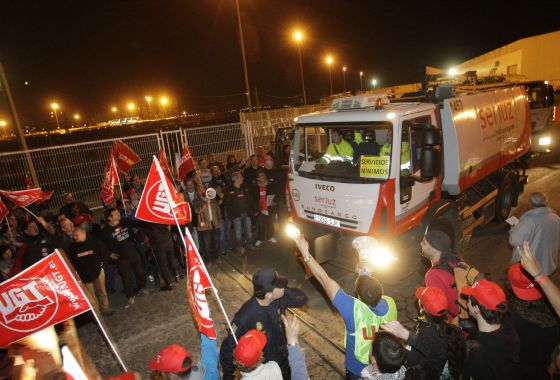
UGT and CCOO militants protest as Zargoza's municipal cleaning vehicles start on their rounds. / EFE
Industry and commerce appear to be the worst affected sectors in
today’s 24-hour nationwide strike, called by Spain’s labor unions in
protest at the harsh labor reforms enacted by the conservative
government of Prime Minister Mariano Rajoy.
While the initial verdict of the Popular Party (PP) administration is that the country is functioning normally, the CCOO and UGT labor unions are talking of “massive support” for the eighth general strike since Spain returned to democracy. The unions are bandying around the figure of 90-percent observance of the stoppage, higher than was claimed during the last 24-hour strike in September 2010, also called in protest at labor reforms.
Spain’s largest business association, the CEOE, has put out a statement describing support for the strike as “uneven.” It says the biggest impact is being felt in the industrial sector, in the larger cities and particularly in the north of the country. Ports are said to have been hard hit.
At a joint press conference with his CCOO counterpart, UGT leader Cándido Méndez said the strike is proving a success with a "very broad" level of observance. Méndez called on the government to sit down and negotiate changes to its labor reform, which is in place as a decree but has yet to become law in parliament.
"We know that Spain is at its limit, but it will go over the edge if these austerity policies are continued," Méndez added, warning the government to think carefully before approving its budget for 2012 in Friday's Cabinet meeting.
The day of protest, set to culminate in marches against the labor reform in many cities, has so remained relatively peaceful. As of 8am this morning, 58 people had been arrested in isolated incidents. Nine people are reported to have suffered injuries, according to the Interior Ministry.
A court in Madrid on Wednesday overruled the central government’s delegate in Madrid, who had argued that the unions’ demonstration route should not be allowed to reach the capital’s emblematic central square, La Puerta del Sol.
Various organizations connected with the 15-M youth protest movement are expressing support for the strike on their websites, and urging people to join demonstrations later in the day. It is the first general strike since the popular protest movement was born in the build-up to regional elections last May.
The outskirts of Madrid saw massive traffic jams, as many workers and parents chose to use their cars instead of the public transportation system, despite the agreement between unions and the administration to guarantee a minimum service on buses and trains, including the Metro subway system. Barcelona also experienced traffic problems during rush hour.
In terms of objective data, figures from the REE national electricity grid operator suggest a reduction in activity this morning. At 5am demand for power was 13.5 percent lower than would normally be expected. At 7.50am it was 21 percent down.
By sectors, the unions say that observance has been near total in industry and transportation. They have offered a figure of 85-percent support in air travel and 82 percent for road transportation services, affecting distribution to stores and other commercial premises. The unions put the observance figure in the postal service at 76 percent. UGT says that 91 percent of workers at the Renfe national train operator and the Adif rail network company are out on strike.
Labor also says it has made a survey of large companies with over 200 employees, and concludes that 91 percent had stayed away this morning. In the media, observance of a the strike is said to be at 65 percent, with a total blackout reported in some regional public TV stations such as Canal Sur, Canal 9, Telemadrid, TV-3 y and Asturian television.
As well as major distribution markets, which have also been affected by the drop in road transportation, El Corte Inglés department stores have been picketed in several cities across Spain. The store in Barcelona’s central Plaza Catalunya has seen several entrances affected during a game of cat-and-mouse this morning involving picketers, El Corte Inglés staff and the Mossos d’Esquadra regional police force.
In Bilbao El Corte Inglés opened an hour and a half late due to the action of picketers.
While the initial verdict of the Popular Party (PP) administration is that the country is functioning normally, the CCOO and UGT labor unions are talking of “massive support” for the eighth general strike since Spain returned to democracy. The unions are bandying around the figure of 90-percent observance of the stoppage, higher than was claimed during the last 24-hour strike in September 2010, also called in protest at labor reforms.
Spain’s largest business association, the CEOE, has put out a statement describing support for the strike as “uneven.” It says the biggest impact is being felt in the industrial sector, in the larger cities and particularly in the north of the country. Ports are said to have been hard hit.
At a joint press conference with his CCOO counterpart, UGT leader Cándido Méndez said the strike is proving a success with a "very broad" level of observance. Méndez called on the government to sit down and negotiate changes to its labor reform, which is in place as a decree but has yet to become law in parliament.
"We know that Spain is at its limit, but it will go over the edge if these austerity policies are continued," Méndez added, warning the government to think carefully before approving its budget for 2012 in Friday's Cabinet meeting.
The day of protest, set to culminate in marches against the labor reform in many cities, has so remained relatively peaceful. As of 8am this morning, 58 people had been arrested in isolated incidents. Nine people are reported to have suffered injuries, according to the Interior Ministry.
A court in Madrid on Wednesday overruled the central government’s delegate in Madrid, who had argued that the unions’ demonstration route should not be allowed to reach the capital’s emblematic central square, La Puerta del Sol.
Various organizations connected with the 15-M youth protest movement are expressing support for the strike on their websites, and urging people to join demonstrations later in the day. It is the first general strike since the popular protest movement was born in the build-up to regional elections last May.
The outskirts of Madrid saw massive traffic jams, as many workers and parents chose to use their cars instead of the public transportation system, despite the agreement between unions and the administration to guarantee a minimum service on buses and trains, including the Metro subway system. Barcelona also experienced traffic problems during rush hour.
In terms of objective data, figures from the REE national electricity grid operator suggest a reduction in activity this morning. At 5am demand for power was 13.5 percent lower than would normally be expected. At 7.50am it was 21 percent down.
By sectors, the unions say that observance has been near total in industry and transportation. They have offered a figure of 85-percent support in air travel and 82 percent for road transportation services, affecting distribution to stores and other commercial premises. The unions put the observance figure in the postal service at 76 percent. UGT says that 91 percent of workers at the Renfe national train operator and the Adif rail network company are out on strike.
Labor also says it has made a survey of large companies with over 200 employees, and concludes that 91 percent had stayed away this morning. In the media, observance of a the strike is said to be at 65 percent, with a total blackout reported in some regional public TV stations such as Canal Sur, Canal 9, Telemadrid, TV-3 y and Asturian television.
As well as major distribution markets, which have also been affected by the drop in road transportation, El Corte Inglés department stores have been picketed in several cities across Spain. The store in Barcelona’s central Plaza Catalunya has seen several entrances affected during a game of cat-and-mouse this morning involving picketers, El Corte Inglés staff and the Mossos d’Esquadra regional police force.
In Bilbao El Corte Inglés opened an hour and a half late due to the action of picketers.
